
Walking The Silent Path Into Nature
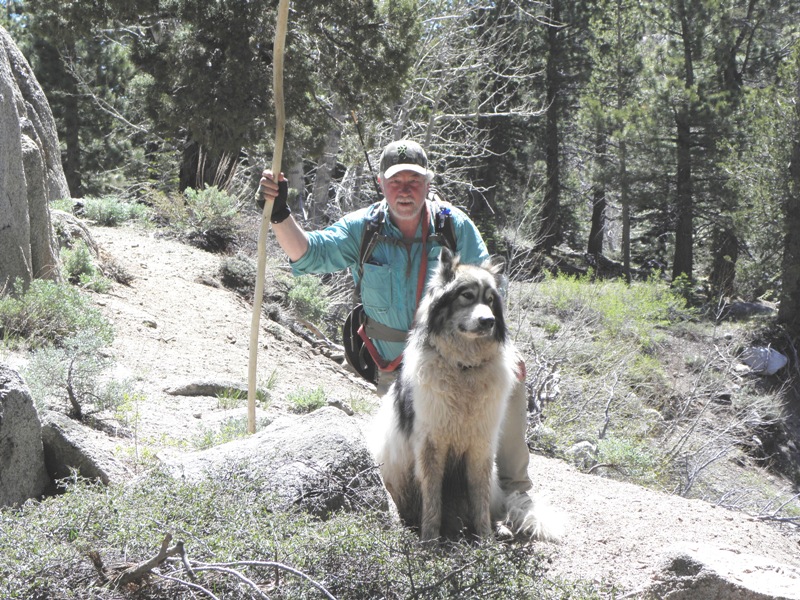
Shiloh and I begin another journey into the wilderness. We start out in the early morning with the fresh scent of pine and the coolness of the mountain air touching my skin. In the background are the sounds of the flowing river that will guide us on our walk. Its gentle course weaving through the valley floor provides us with a sense of solitude, freedom and peace of mind. On our accent, this calming river soon narrows into rocky crags churning these calm waters into a violent torrent beast swallowing up anything that gets in its way. Its origins are high in the Sierra Nevada mountains from the spring time snow melt where we have set our destination. And from the Kennedy Meadows Valley we began from, it then turns into the Stanislaus River.
Our final destination is Kennedy Lake, an eight mile hike with an accent of a thousand foot elevation taking us up to the 7,800 foot mark. The trail we walk we know like an old friend, though we have been on this trail only a couple of times. I remember my first time on the trail I had experienced a slight sense of fear of the uncertain and the unknown that followed my every step, due to the fact this would be the first time experiencing the wilderness alone. Shiloh walks ahead of me with confidence with his nose to the ground picking up all those familiar scents he had experienced from our past walks on this trail. His excitement peaked knowing we would once again be living in the wilderness. And for me, being back, experiencing nature with Shiloh was always a special time to share those wonderful experiences with. The wilderness was a place Shiloh and I soon fell in love with and happily called our home.
This journey we have shared together in the wilderness has become a spiritual journey for me and I always felt a sense of the sacred all around me. I had a sense of belonging in the magical wonder of nature and sharing it with my best friend and wilderness companion, Shiloh. Whether we walked alone or with a friend joining us, it was always a journey with Shiloh. The friend that joined us became just a shadow of our existence together in the mountains.
The trail we walk on has many stories it could tell if only it could speak of its past. The many hidden footprints of hikers, backpackers, fishermen, hunters, people on horseback, the workers and mule trains carrying supplies and equipment that built the Relief Reservoir, the lost footprints of the pioneers that explored these lands and of course the lost footprints of the ancient people who once lived here for thousands of years prior to the white man’s arrival. I wonder how many people think of these things while making their own story on this trail. How many of us think about the original people who once called this area their home and then were driven from their home by the white man and almost totally exterminated for just being there? How many Indian spirits still walk this trail, shedding tears of what was once a thriving community of Indian tribes who loved this land and their way of life living with nature and being part of that flow of life? In the central Sierra Nevada Mountains such Indian tribes as the Sierra Miwok, the Mono, the Mountain Maidu, the Washoe and on occasion the Northern Paiutes made their seasonal homes here or visited for hunting and gathering food and/ or trading with other tribes.
While sitting in camp at Kennedy Lake viewing the alpine meadow and surrounding rocky mountain peaks or taking walks in the small valley, I would imagine what it was like with the presence of Indian people living here. Camping here as Shiloh and I are doing, living with nature, living off the land for sustenance, hunting, fishing, foraging and gathering wild edible plants for food and plants for medicines – each person working in their role within the community, working together in a cohesive manner for the benefit of the whole tribe and for their survival.
The Indian tribes who visited these areas knew them intimately. They knew when and where the animals would be, their habits and behaviors, they would know when to find and pick wild edible plants for food and plants for medicine. They would have this incredible connection with their surroundings that few of us today could even imagine having. Most weekend campers today only see a small glimpse of what is around them in nature. They are usually there to use her rather than connect with her. Most don’t see nature as sacred thus having very little or no respect for nature – Mother Earth. On the other hand, the Indian People had a high reverence with nature, a deep connection and respect for all living things. Nature and all life were sacred to them. They lived in harmony and balance with nature because they understood this to be necessary for their own survival and their responsibility to the Creator for providing the sustenance needed for their survival. They viewed the animals, insects, plants, trees and even the rocks as relations. They understood that the land, water and air were vital and necessary natural resources for all life and again these resources were sacred. The whole of the Indian communities were to celebrate life in every part of their lives through storytelling, song, dance, ceremonies, language and culture. With all these things, they had a sacred relationship with. What type of world would it be if we all lived this way? It would definitely be a much healthier place to live on a physical, emotional and spiritual level.
The more I view into and experience this vastness of the natural world; I begin to feel the sacredness of all life and my reverence for all life on our planet. In a big part, I have to thank the indigenous cultures around the world for teaching me and sharing with me, their knowledge and wisdom on our relationship with Mother Earth.
It is very unfortunate that most have forgotten this connection and relationship with the natural world. We have chosen to live in a synthetic lifestyle, completely removed from the natural world where the consumption of stuff is more important than a healthy planet and with little concern for other life we share our home with. Nothing is sacred, but our need to make money and to spend it on useless things. These things do not give us a sense of being but rather makes our lives more meaningless. We have become a modern culture of people that intentionally and unintentionally destroys people’s lives and cultures who choose to still live in their traditional ways that are closely tied to the natural world. We call them primitive and uncivilized because they choose to live as their ancestors have lived for thousands of years. We have become so far removed from the natural world, we see traditional indigenous cultures as strange while we live in a world that continues to destroy and poison our planet with the very meaningless things we consume. Things that are not natural take on more of an importance than life itself in our modern world. To me this is very sad that we could even reach such a moment in time to simply ignore the destruction we are doing to our planet.
In the Lakota tradition they have the teachings of The Red Road and The Black Road through stories that convey the respect and reverence for life. It exemplifies the spiritual understanding that all life is part of the unified, interrelated web and that each part is precious and necessary to the whole. I would like to share with you what Thunder Horse has written in part on this subject:
“There are many roads in life, but there are two that are important; the Red Road and the Black Road. They represent good and bad in every one’s life. It’s the two choices people have to make frequently in life. The Red Road is the good way, the good side, and the right choice. It is a road that is difficult with dangers and obstacles that are hard to travel on. The Black Road is the bad way, the bad side, and the wrong choice. The Black Road is wide and easy to travel. The Red Road and the Black Road appear in our lives not as roads but as the personifications of right and wrong, good and bad, light and dark.
Truth is the marker along the roads we travel in life. The Red Road has many markers. If you choose the Black Road, there is only the illusion of truth. We can be influenced by the truth or by illusion. Sometimes truth is like the wind. You cannot see it, but you can see the effect it has. Truth is also like the sunrise and sunset. We see the sun come up over the eastern horizon in the morning and then disappear behind the western horizon in the evening. From the perspective of our existence on a spinning globe, the sun appears to “rise” and “set.” In reality the sun does neither. Living a humble and giving life keeps one on the path of the Red Road.”
The reason I have written this is because I believe we are now standing on the edge of the cliff of humanity ready to jump for the sake of filling our personal needs with empty and meaningless materialism and because of this need, we are dramatically impacting the health and sustainability of our planet. The voices of cultures that still live close to the land – to Mother Earth, are telling us, we must change our ways, we must begin to respect Mother Earth and once again live by her truths. I cannot convey in my words the wisdom and teachings of the North American Indians – the Native Americans of the United States and the First Nations of Canada, so I encourage you to learn more about what they can teach us so we can begin to heal our planet and regain a spiritual connection with all life.
 Blogs In Nature
Great, Quality Content for The Ultimate Guide, A lot of thanks for sharing, kindly keep with continue !!
LikeLike
Thank you Ruchi-Singh and thank you for visiting my blog. feel free to share with others.
LikeLike